
Failure of large-scale commercial constructions does not occur because someone forgot how to construct walls. It happens when numerous factors such as decisions, individuals, timetables, materials, permits, and expectations no longer function together. That is where commercial project management becomes essential.
The project manager is among the most important links between all the parties involved in commercial construction project including owner, designers, contractors, subcontractors, suppliers, etc. It is not only about keeping track of the schedule. It is to keep the project organized, identify problems early, support good decisions, and help turn a complex plan into a finished commercial property.
Project management as one of the services of Tip Top Builders, along with construction management, architecture and design, real estate, and business development, fits in a broad concept of commercial construction. Moreover, the firm has over 15 years of experience constructing gas stations, convenience stores, and commercial buildings in Texas.
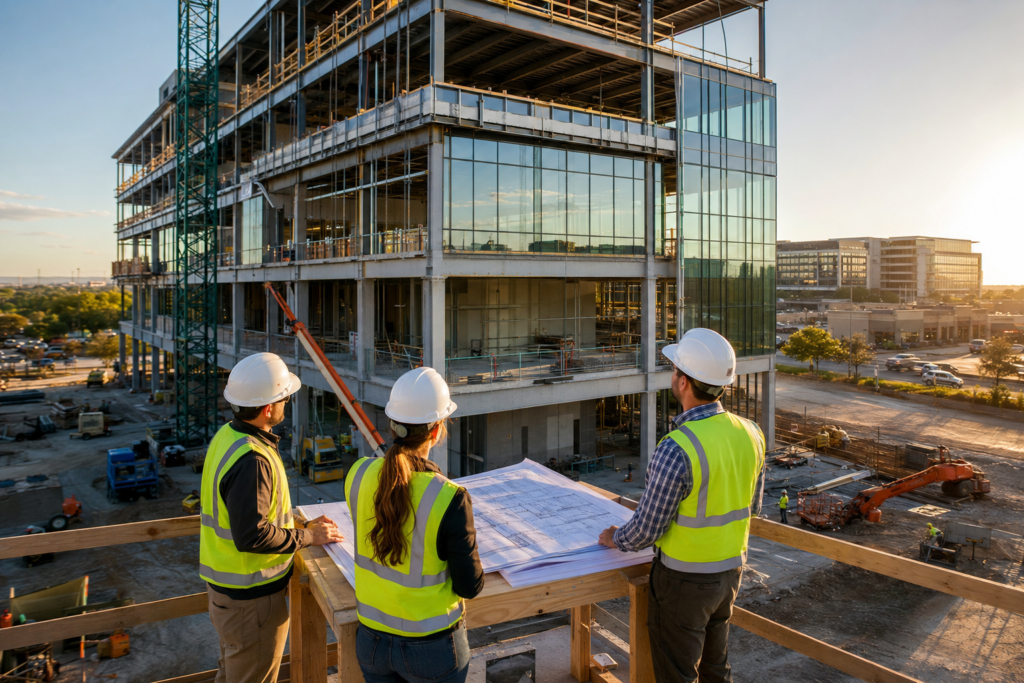
Then, what is the role of a project manager in a large-scale commercial project?
Turning the Plan Into an Actionable Roadmap
Commercial construction begins with the goal; however, mere goals do not construct buildings. The project manager helps in converting an overall objective into activities, milestones, and deadlines.
The result becomes a roadmap that helps the team with a practical plan to move forward through design, procurement, site preparations, construction, inspection, installations, finish works, and handover.
Effective planning goes beyond mere date compilation. This is because the schedule also demonstrates dependencies among activities such that the manager needs to understand the consequences of delays of one critical activity to another.
Coordinating Different Teams
Commercial construction projects may include many parties, including architects, engineers, general contractors, subcontractors, suppliers, inspectors, property owners, etc. Each party has its obligations, and it falls under the responsibility of the project manager to coordinate their actions.
This is especially important when the work of one team becomes the starting point for another team. Electrical work may depend on completed framing. Equipment installation may depend on prepared spaces. Inspections may need to happen before the next phase can proceed.
Without coordination, small misunderstandings can become expensive delays.
Managing Communication
The property owner does not have to be a construction expert in order to understand their project. Among many other functions, one of the most valuable functions of the project manager is to translate complex information into action.
This includes weekly progress meetings, status reports, scheduling reviews, issue tracking, and direct communication for decision-making.
Effective communication is not about increasing message exchange but about making sure that the correct message will reach the right person at the right time.
A good project manager also delivers bad news. If there is an issue that could potentially impact either cost or schedule, the owner must be informed in advance.
Protecting the Schedule
Dates can also be significant in commercial properties. The opening date may be linked to staffing, stock, tenant promises, financing, marketing, and customer expectations.
The project manager monitors progress relative to the schedule and identifies risks that could threaten the timeline.
If there is a change, the objective would not be to pretend as if nothing has happened and stick with the original schedule. It will be for the project manager to evaluate the effects and assist the relevant teams to formulate a realistic solution.
Therefore, schedule management is an ongoing process as opposed to producing a document at the start of the project and ignoring it.
Watching the Budget
Project managers also play a role in financial control, where they monitor issues such as commitments, changes, progress, and procurement, among others, that affect project costs.
While the project manager may not always make financial decisions, they facilitate understanding of the situation by the owner and the teams.
The reason being is that in most cases, design change, site conditions, materials, or schedule changes would affect the budget.
Early visibility gives owners more choices. A problem that is identified while there are several options is easier to manage than one discovered after the money has already been spent.
Solving Problems Before They Grow
Problems are normal on complex construction projects. The difference between a manageable issue and a major problem lies in how soon the issue is identified and managed.
A project manager watches for warning signs. A delayed approval, missing material, design conflict, or unexpected site condition can become more serious if nobody takes ownership.
The manager’s role is not to eliminate every problem. That is unrealistic. It is to help the team respond before a small issue becomes a large one.
Managing Changes
Commercial projects can change after work begins. Owners may revise a requirement, a design issue may be discovered, or site conditions may require a different approach.
Changes need to be documented, evaluated, communicated, and incorporated into the schedule and budget.
A project manager helps prevent informal decisions from creating confusion later. Everyone should understand what is changing, why it is changing, and what effect it may have.
That discipline protects relationships as well as the project itself.
Helping the Owner Stay Focused on the Business
The owner is ultimately responsible for the investment, but they may also be running a business at the same time.
A project manager can reduce the amount of day-to-day coordination the owner has to handle personally. Instead of chasing every subcontractor or supplier, the owner can receive organized information and focus on decisions that actually require their attention.
That can make the construction experience less overwhelming.
Why Commercial Project Management Matters
Large-scale construction is a team effort, but teams need coordination. Commercial project management provides that coordination by connecting schedules, people, information, budgets, quality, safety, and decisions.
For business owners, the value is often easiest to see when something goes wrong. A capable project manager can help identify the issue, explain its impact, bring the right people together, and move the project toward a solution.
The Person Keeping the Pieces Moving
Project management does not necessarily include the most conspicuous figure in commercial construction projects, but it can have a tremendous effect on project progress.
The best project managers bring organization without unnecessary bureaucracy, communication without noise, and problem-solving without drama. They understand that the building is not the only thing being constructed. The team is also building a schedule, a budget, a working relationship, and ultimately a business asset.
For owners planning a large commercial build, asking about commercial project management should be part of the contractor selection process. Find out who will manage the project, how updates will be handled, how changes are documented, and what happens when something does not go according to plan.
A strong manager cannot remove every challenge from construction. What they can do is make the challenges easier to see, understand, and solve before they become bigger obstacles.
Frequently Asked Questions
What does a commercial project manager do?
An effective project manager for a commercial venture is responsible for organizing the project resources, schedules, communication, budgets, procurement, quality and decisions for construction projects. Project management responsibilities differ depending on the situation, but the key function is the organization of the project towards its objective.
When should I hire a commercial project manager?
Project management becomes the most effective when the process begins early, preferably during the project planning phase and pre-construction. Early involvement in the process gives the project manager an opportunity to organize schedules, responsibilities, communication processes, procurement, and other aspects of project management.
How does commercial project management help control costs?
Project management increases cost visibility through monitoring changes, commitments, procurement, progress, and other factors that may affect costs. Early problem recognition offers better opportunities for owners to make certain adjustments regarding project scope and other decisions.
Do I need project management for a large commercial build?
Large or complex projects usually need project management since such projects usually contain various stakeholders and dependencies. The more complicated the project is, the more useful the coordination, communication, scheduling, and problem-solving become.