
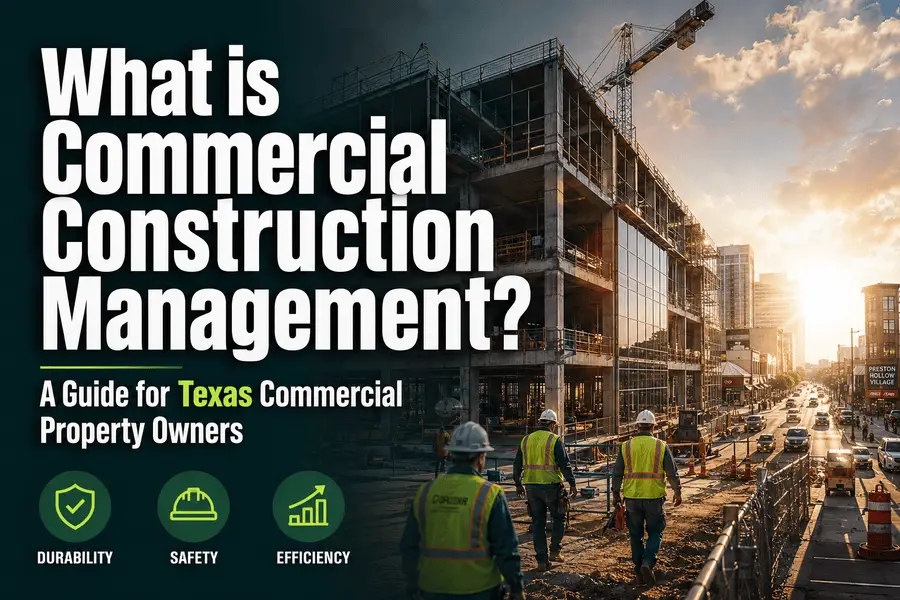
Starting a commercial project in Texas, whether it is a strip retail center in Houston, a warehouse in Katy, or a medical office in Sugar Land, is fraught with opportunities. High population growth rate, favorable climate for business activity, and companies moving to Texas make the state one of the most profitable areas for real estate development in America. The amount of planning and communication that need to be done with the architects, engineers, subcontractors, and city authorities can easily scare even the experienced developer.
If there isn’t strict supervision, minor mistakes become expensive delays, material waste, and construction problems. This is where professional commercial construction management in Texas, becomes your greatest asset. It serves as the bridge between your high-level financial vision and the reality of a busy, fast-paced job site.
This is an overview of commercial construction management services, which will help you save money, stay on schedule, and create a building that would be of high quality.
Quick Summary
- Active Project Oversight: Construction managers control all stages of budgeting, scheduling, design review, and subcontractor coordination in order to provide quality control of their work.
- Choosing the Right Delivery Method: Knowing the difference between agency CM and CM at risk services is necessary to define how risks are distributed between the owner and the contractor.
- Preventing Budget Overruns: Value engineering and cost control are used to identify budget problems before starting a project.
- Navigating Texas Regulations: Effective commercial construction management guarantees strict observance of Texas building codes, permits from the municipality, and environmental regulations in the region.

What is Commercial Construction Management?
At its core, professional commercial construction management is a specialized management service that applies highly structured, holistic techniques to oversee the planning, design, and construction phases of a project from start to finish.
Rather than leaving the property owner to act as the primary referee between the design team (architects and engineers) and the building team (general contractors and trade workers), a construction manager (CM) acts as the owner’s dedicated representative. This guarantees that all the decisions taken on the site match up with the owner’s budget, timeline, and quality requirements. This is especially true when it comes to commercial real estate; one week’s delay may amount to a loss of thousands of dollars in rent.
Contrary to the opinion of some, a construction manager does not spend most of his time observing the progress of commercial construction management activities at a site. The main role of a commercial construction manager is to harmonize the aspects of the projects in terms of cost, time, scope, and quality. He helps to solve the engineering problems that the property owner faces by giving him sound business advice on how to proceed without any knowledge of civil engineering.
The Key Phases of Construction Management Services
A successful commercial construction project does not just occur once the crew arrives on-site. Commercial construction management services include three key phases of a project.
Phase 1: Pre-Construction and Planning for Commercial Construction Management
Prior to the arrival of concrete mixers, the groundwork for success is already laid. The truth is, the decisions that you will make prior to commercial construction management, specifically will play the biggest role in influencing your budget and project schedule. Here are some important functions that your CM will perform during pre-construction:
- Feasibility and Site Analysis: Analysis of soil conditions, availability of utilities, and Texas zoning laws in order to determine if your land is ready to host the building you wish to build.
- Value Engineering: Analysis of architectural design in search of possible alternative materials, structural solutions, and mechanical system which could reduce cost and keep buildings strong, durable, and visually appealing.
- Accurate Cost Estimating: Development of an extremely detailed and accurate line-item budget. This means getting actual bid prices from qualified subcontractors.
- Constructability Reviews: Analysis of blueprints in order to spot any inconsistencies and/or omissions and avoid costly field orders.
Phase 2: Commercial Construction Management Execution and Site Supervision
After groundbreaking starts, the CM will concentrate on day-to-day activities and enforce strict standards at the commercial construction site.
- Subcontractor Coordination: Scheduling specialized contractors such as foundation crew, structural steel fabricators, and MEP (mechanical, electrical, and plumbing) specialists in order to achieve seamless coordination.
- Quality Control Inspections: Ensuring that everything follows the architectural plans, manufacturer’s specs, and local structural codes for safety.
- Schedule Control: Monitoring progress on a day-to-day and week-to-week basis against the master plan in order to avoid any supply chain snags, labor problems, or weather setbacks.
- Safety Management: Adhering to OSHA standards and implementing safety procedures on site to mitigate liability and avoid project shutdowns.
Phase 3: Post-Construction and Project Closeout
The work is not done once the walls go up and the paint is applied. The final phase involves a complex series of administrative and physical checks:
- Punch List Resolution: Systematically going through the facility together with the architect to locate and rectify any aesthetic or functional problems.
- Permit Sign-offs and Commissioning: Coordinating with the local municipality inspectors to get a Certificate of Occupancy (CO) and testing all of the major building systems (HVAC, electric, and fire suppression) to make sure they function smoothly.
- Document Handover: Putting together the operations manuals, warranties for all the equipment, and “as-built” architectural plans in a closeout package for the owner.
Agency CM vs. CM at Risk (CMR): Understanding Your Options
There are two basic ways of hiring a firm for commercial construction management services. The proper selection will depend on your comfort with financial risk, the timeframe of your project, and your level of participation in the process.
Agency For Commercial Construction Management
Under this traditional structure, the construction manager acts strictly as a professional advisor to the owner. The owner holds all individual contracts directly with the architect, general contractor, and major subcontractors. While the Agency CM provides expert guidance, they do not guarantee the final cost of commercial construction or the project schedule. The owner retains maximum control over every single decision but also bears all the financial risk of cost overruns and delays.
CM at Risk (CMR) Services
For many commercial construction management or developers in fast-moving Texas markets, utilizing CM at risk services is highly preferred. In this arrangement, the construction manager transitions from an advisory role during the design phase to the role of a general contractor during the commercial construction phase.
The CM assumes the responsibility of providing a Guaranteed Maximum Price (GMP) prior to vertical construction starts. In this scenario, the manager absorbs the excess costs associated with anything beyond the negotiated GMP, shielding the owner from possible cost spikes.
Why Local Expertise Matters in Texas Commercial Construction
Construction principles are the same everywhere; however, construction practices tend to be very region-specific. Successfully conducting construction work in Texas requires detailed knowledge of local regulations, weather conditions, and regional geology. Cooperation with a specialized company that specializes in commercial construction management in the area guarantees proper consideration of these matters.
Navigating Houston’s Unique Development Rules
Houston is famous for its lack of traditional zoning laws, but this does not mean it is a regulatory free-for-all. In fact, the city enforces highly strict municipal ordinances that can catch out-of-state developers off guard:
- Deed Restrictions: Private agreements regarding the use of land, building material, and architectural design in certain areas.
- Off-Street Parking Requirements: Precise ratios of parking spaces in relation to square footage of retail, office, and industrial space.
- Stormwater Detention Regulations: In view of potential flooding, there are strict civil engineering requirements in terms of stormwater detention ponds and drainage systems provided by the Harris County Engineering Department and the City of Houston.
Designing for Texas Climates and Soils
A skilled local manager understands how to construct in the tough Texas environment:
- Foundation Stability: Texas soil, especially clay in the Houston-Galveston area, is well-known for moving and swelling. It is essential that foundations be constructed using sophisticated post-tension slabs, drilled piers, or deep grade beams to avoid foundation settlement.
- Wind-Load Engineering: Structural steel and roofing for buildings in the coastal zones need to be constructed in accordance with TDI windstorm specifications to withstand the fast hurricane winds.
- High-Efficiency HVAC: Efficient climate control systems are necessary for commercial buildings in Texas to combat extreme summer heat waves. Effective insulation and cooling roofing materials are critical to keep costs low during operations.
Leveraging Construction Technology for Maximum ROI
Technology used in construction has evolved far beyond traditional tools like hammers and nails. Modern construction technology is extremely significant in reducing the timeframe of projects and eliminating miscommunication problems. High-performing companies use sophisticated technology to ensure an efficient building process:
- Building Information Modeling (BIM): Building precise 3D computer models of the building before starting work. This helps engineers and architects to perform clash detection tests to determine whether a structural beam collides with an HVAC duct in a 3D computer model, not on-site.
- Cloud-Based Project Management Portals: Implementing technology such as Procore to give owners, architects, and subcontractors the ability to have access to all of the logs, change orders, submittals, and progress pictures in real time. In doing so, all of the individuals will work with the most up-to-date versions of the plans.
- Drone Site Surveys: Using aerial drones to do quick topographical surveys, structure monitoring, and roof inspections.
As a result of integrating these technologies, managers or experienced construction experts in Texas are able to reduce their schedules and minimize any material waste while offering owners the highest degree of visibility into their project.
Frequently Asked Questions
A general contractor is employed after the architectural design has been completed to construct the project for a predetermined fixed price. The construction manager is hired prior to the start of commercial construction management project when the design is being developed to provide advice on costs, scheduling, and constructability and will sometimes serve as the building entity.
The ideal time frame to hire a construction manager for commercial construction management would be prior to design or early schematic design in order to provide early value engineering services.
A GMP is a contract structure commonly used in CM at risk services. The construction manager agrees to a maximum cap on the cost of the project. In the event that the build exceeds the capped limit, then the CM shoulders the burden of losses incurred; but in the case where it falls below the cap, any savings made are normally shared between the CM and the owner, based on contractual agreements.
The fees may vary, being charged either as a straight professional fee, as a percentage of the total cost of construction, which varies from 2% to 15%, or a negotiated rate per hour.
Yes, particularly in designated coastal counties. As part of the Texas Department of Insurance (TDI) requirements, a building undergoes inspection during its commercial construction management phase to ascertain its ability to withstand wind forces of hurricanes. Without a TDI Certificate of Compliance (WPI-8), obtaining commercial property insurance can be extremely difficult.
The manager has experience in working with the local city’s best subcontractors, has a fast understanding of the permitting process in the city and how to design foundations to withstand expansive clay soil and rainwater in the area.
Maximizing Your Commercial Investment
In essence, hiring a professional commercial construction management firm is an investment in the minimization of risks. By hiring a manager during the preliminary planning stage of construction, one ensures that every architectural design is realistic, feasible, and affordable to construct.
Choosing a firm with a deep portfolio in local Texas markets guarantees that your project benefits from established subcontractor relationships, streamlined municipal permitting, and tested structural processes. Whether you opt for traditional advisory management or leverage the budget security of CM at risk services, having an expert in your corner ensures your commercial property is delivered on time, within budget, and ready to generate strong, consistent returns.
Ready to take the stress out of your next commercial build? Contact Tip Top Builders today to discuss your project goals and learn how our tailored commercial construction management solutions can bring your vision to life on time and on budget.